

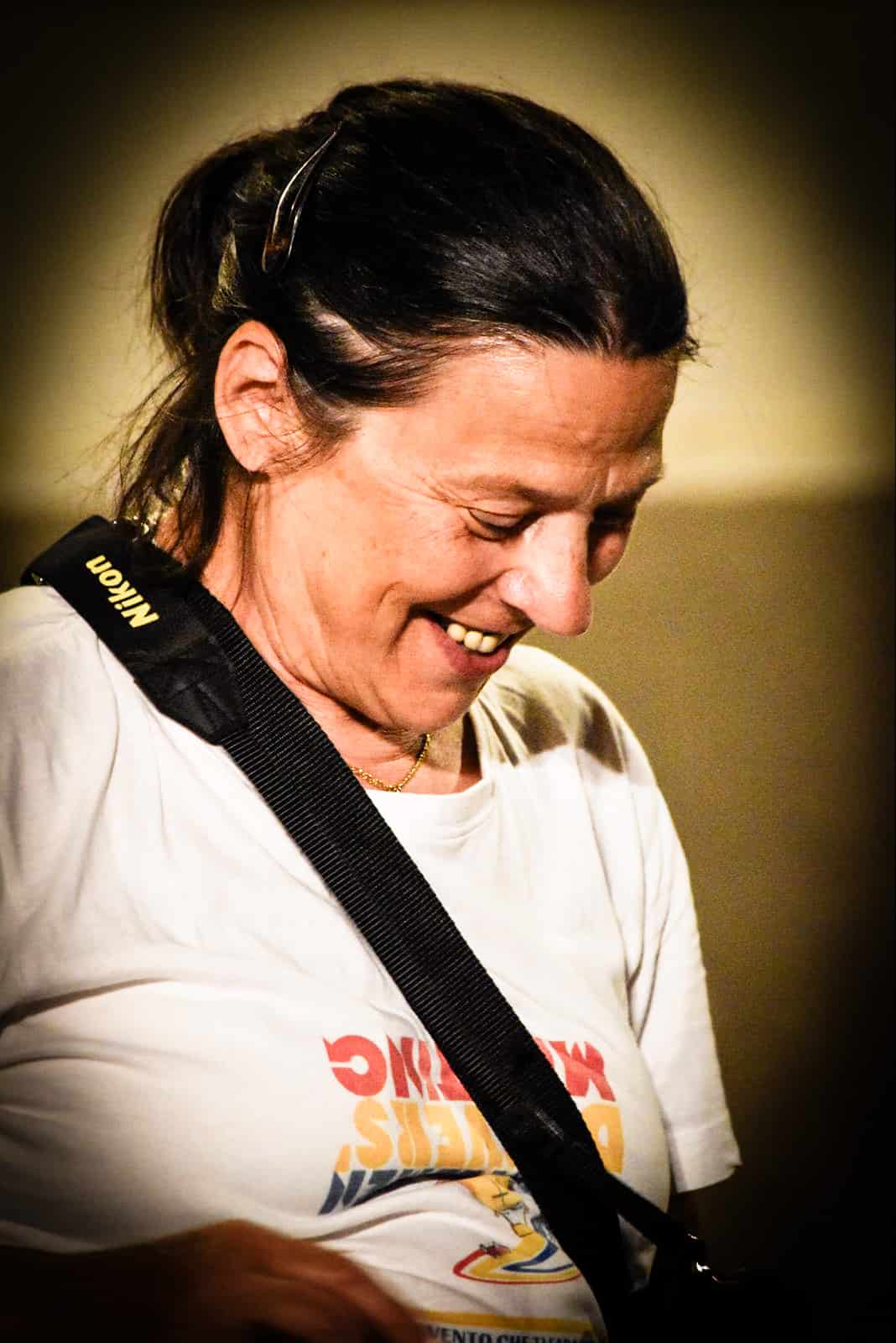
It was 1983 when Marzia Pozzato entered the gates of the Filatura di Tollegno mill, emerging 42 years later with a solid background of expertise and a wealth of images captured with her camera. A passionate reporter, with a clear gaze and a smile plastered on her face, Marzia, recently retired, has used her lens to chronicle the company’s people, production, collections, and style, becoming a visual memory of a long stretch of Tollegno 1900’s history.
Marzia, how did you end up at Tollegno 1900?
I joined Filatura di Tollegno thanks to my mother, who worked at Tessitura di Tollegno as a mender. It was she who handed my job application to Ennio Crippa, then head of personnel, back in 1983, about two years after I graduated as a dyeing chemical expert. However, since I also had a certificate of completion of a computer course, I was hired as a survey and statistics worker. I was responsible for uploading data to the then-new IBM computer system, the forerunner of the new ERP systems. I remember well that I used a “dumb” terminal, because it had no memory of its own and was incapable of processing calculations: its only function was to transmit the data to the central system, which processed them and transferred them to punched cards kept in a safe. In the morning, we had the order and production printouts ready for the day’s work.
What division were you in?
I worked in the production planning office. My boss was Ugo Domenico, but I owe my preparation and the professionalism I’ve developed to two women: Chiara Avventura, who gave me a real and authoritative wake-up call about work and interacting with colleagues, and Wally Crescenzio, who taught me the rules of the trade. Two other women, Patrizia Acquadro and Pasqualina Secondi, taught me how to use programs and the terminal. Over time, however, I took on a bit of everything: order management, spinning scheduling, switchboard, but above all, I developed and implemented computer programs that are still used in production today. But that’s not all. I also oversaw the development of the data processing center for weaving, as well as providing training to colleagues.
Your 42 years of service represent almost a third of Tollegno 1900’s history: how have you seen the company change over the years?
A great deal. The 1980s were marked by a major crisis. I remember the union struggles and the layoffs. It was an uncertain period, with fears of closure. Then came a change of direction, and in 1986, Ermanno Germanetti turned the tide of Tollegno 1900’s fortunes. The 1990s, however, began with the first major technological and IT evolution. The first personal computers arrived, and I was among the protagonists of a momentous change: the new IT network. Each office could create customized workstations to improve, renew, and speed up its work system. Paper, printouts, telex, and the most modern fax machines were abandoned, allowing for direct work with email and order/production/warehouse reporting. You don’t hide your pride in having activated the first network of five personal computers, the 4.8.6. I was later entrusted with the ultra-modern and ultra-fast Pentium, which ran the first spinning mill production planner and scheduler. Manual work instructions became production notes printed directly in the department.
The 1990s were also marked by another important change…
It’s true. Toward the end of the 1990s, with the globalization of markets, Tollegno 1900 also began to relocate production to Poland, where, initially, it produced classic raw yarns for weaving and knitting. Subsequently, the tops treatment and dyeing operations were also moved. At the time, well aware of the inevitable restructuring of production and personnel, we attempted to maintain the bare minimum to continue our production and preserve jobs. However, the law of the market is ruthless: faced with intense low-price competition, to remain operational, we decided to change our production policy, which led to a pleasant period of stability and employment.
Another change occurred in the first decade of the 2000s.
A change that, in my opinion, was not so positive. There was, however, one positive aspect, and it corresponded with the installation of the A new bobbin dyeing plant revolutionized the entire production process, both in terms of quantity and quality. This led to the dismantling of the skein dyeing plant and the old, inefficient bobbin dyeing plant, with inevitable repercussions on the reorganization of work and personnel. Thanks to the merger between Tollegno Filati and Tollegno Tessuti, many of us, thanks to the great and admirable work of Annamaria Coda and Ermanno Germanetti, always attentive to his staff, found roles in other areas, but always within the group. Few people perhaps know this, but entire families worked at Tollegno 1900.
Were there particularly challenging years?
The darkest years came when Ermanno Germanetti fell ill: it seemed as if everything could end at any moment. We can only applaud the work done by his sons, Lincoln and Giovanni in particular, who persevered and carried on their father’s legacy.
And we come to the present day….
Times have changed, and Tollegno 1900, after its transition to the multinational Indorama Ventures, is preparing for a new epochal transformation, which I have witnessed and, more importantly, been involved in, although I will not be able to see the project begin. This project coincides with the IT system upgrade adopted to accommodate new regulations for warehousing, sales, and sustainability. A system suited to the “new world” and the challenges associated with a complicated and unpredictable historical moment. It will now be up to the new generations to carry it forward with the enthusiasm and strength that have always distinguished the spirit of Tollegno 1900.
If you had to identify some key moments that have shaped the company’s history during your tenure, which ones would you identify and why?
In my opinion, there have been two key moments that have marked the growth of Tollegno 1900, both preceded by dramatic crises that led to layoffs, staff reductions, and a reorganization of the production system. The first step occurred in 1985, when the company became part of the Germanetti family. Mr. Ermanno, the founder, represented for us all a great man and a capable entrepreneur who always managed the company with an eye on business but, above all, with a heart for his employees. The company, then in crisis, began to revitalize itself thanks both to the work of two key figures (Andreotti and Perone), who brought innovation to the development of new products, and to the arrival of valuable clients such as the Max Mara and Benetton groups. I remember standing at the Telex at the end of the day waiting for orders to arrive, and I’ll never forget the joy of receiving the first substantial quantities.
When did the second epochal moment occur?
The late 1990s. With the advent of market globalization, to address the increasingly fierce battle over costs, the production of raw yarns was moved to Poland. Thus was born Tollegno Poland, a true jewel of a completely renovated production facility. There were many pros and cons, but this move allowed the company to look to the future and remain among the world’s leading wool yarn producers. A long period of growth and stability followed, confirmed by the numbers: we produced and sold 3,500,000 kg of yarn per year, and the group’s employees reached 2,000.
Marzia, however, is not only passionate about data and IT innovation, but also about photography. A passion that led you to become the company’s official photographer. How did this love arise?
My passion for photography has been ingrained in me since I was a child, watching my dad paint, even though I couldn’t draw. However, I fell in love with a Polaroid-type camera because it captured images like my dad did with his paintings. Many years passed before I could afford a camera of my own. I remember sharing this love for photography with two other dear colleagues, the data processing center manager Luigi Ghiardo and the great quality manager Emilio Zanini. It was he who encouraged and motivated me to pursue this passion.
Was there a particular circumstance involving the company that led you to be chosen to immortalize it?
In 2016, during the second Historic Lana Cat Rally Trophy, I asked Giovanni and Lincoln Germanetti if I could take some photos of the cars. They immediately said yes and were delighted with the work, so much so that, in the years that followed, I became the official photographer for the company’s events, collections, and historical archives. In 2018, my camera and I were invited to take some shots on behalf of Tollegno 1900 during the Special Olympics, a powerful and unforgettable experience.
Are there any particularly significant shots of the company that you’re fond of among those you’ve taken?
Definitely the first shots at the rally, a picture of the Tollegno 1900 industrial complex with the rainbow behind it, which I took right after Ermanno Germanetti passed away: I thought I could see his smile. I’m also fond of some images of the collections created in our Sala Luce.
Is there a shot you wish you could have taken but couldn’t?
Honestly, no, because I’ve always been very free to express my creativity and give shape to my vision in Tollegno 1900…
If, however, you had to summarize Tollegno 1900 in one image, what would you focus your lens on?
I would definitely point it at the old road that workers walked to work, and that I myself used to walk with my mother. The road is a unique mix of flowers and many stones…and then the stream…
In 2025, your long professional experience at Tollegno 1900 will formally end: what has this career path taught you, which you’ve also brought into your personal life?
I learned to count to ten, curbing my impulses and thinking about what to do. I learned about fatigue, the fear of losing my job, but also about tenacity and pride in achieving my goals. I experienced parallel moments of difficulty and serenity, and I understood the difference between friendship and knowledge. I laughed and cried. I learned what life is in all its aspects…
Let’s take stock of your professional career: what did you love about your job? What made it challenging?
I loved the possibility and freedom of being able to reinvent my own work every day, responding increasingly quickly and effectively to the various requests. What made the journey a bit more complicated, however, was the penultimate direction. But even in this case, I still look for the positive: while it has clipped my wings a bit, it has also allowed me to challenge myself, pushing me to do new things.
What advice would you give to someone new to your job?
I recommend never stopping learning, never feeling like you’ve arrived, and always being curious.
What will you miss about your professional life?
Definitely the opportunity to create new IT tools and put them into practice. Putting myself to the test is part of my DNA.
Let’s look into the future: any plans for 2026?
The most challenging thing will definitely be learning to be a grandmother! Then, continuing to dedicate myself to photography… I’ll think about the rest day by day.
If you had to take a shot that represented your “tomorrow,” where would you set it?
Be it the sea or the mountains, it doesn’t matter; the important thing is that in front of me is a storm that has just passed and a new rainbow.
One last trip down memory lane: in your long professional career, you’ve undoubtedly met many people. Is there anyone you feel grateful for or from whom you feel you’ve learned something important?
The list is truly long, and perhaps I’ve unintentionally forgotten someone. I’d definitely say Mr. Ermanno, Mr. Lincoln, and Mr. Giovanni; Mr. Zanini, Mr. Andreotti, Mr. Busato, Mr. Ortone, Mr. Basso, Mr. Pellizzari, Mr. Anselmetti, and Mrs. Annamaria. But last but not least, my colleagues, all those who have always been with me: Ms. Stefania, Ms. Marika, Ms. Isabella, Ms. Nicoletta, Ms. Cristina, Ms. Roberta; Mr. Fantini and Ms. Barba. And how could I not mention my four super colleagues at the office… I could go on and on… All people who believed in me, helping me make my work always new and exciting. All with a touch of affection and friendship.