



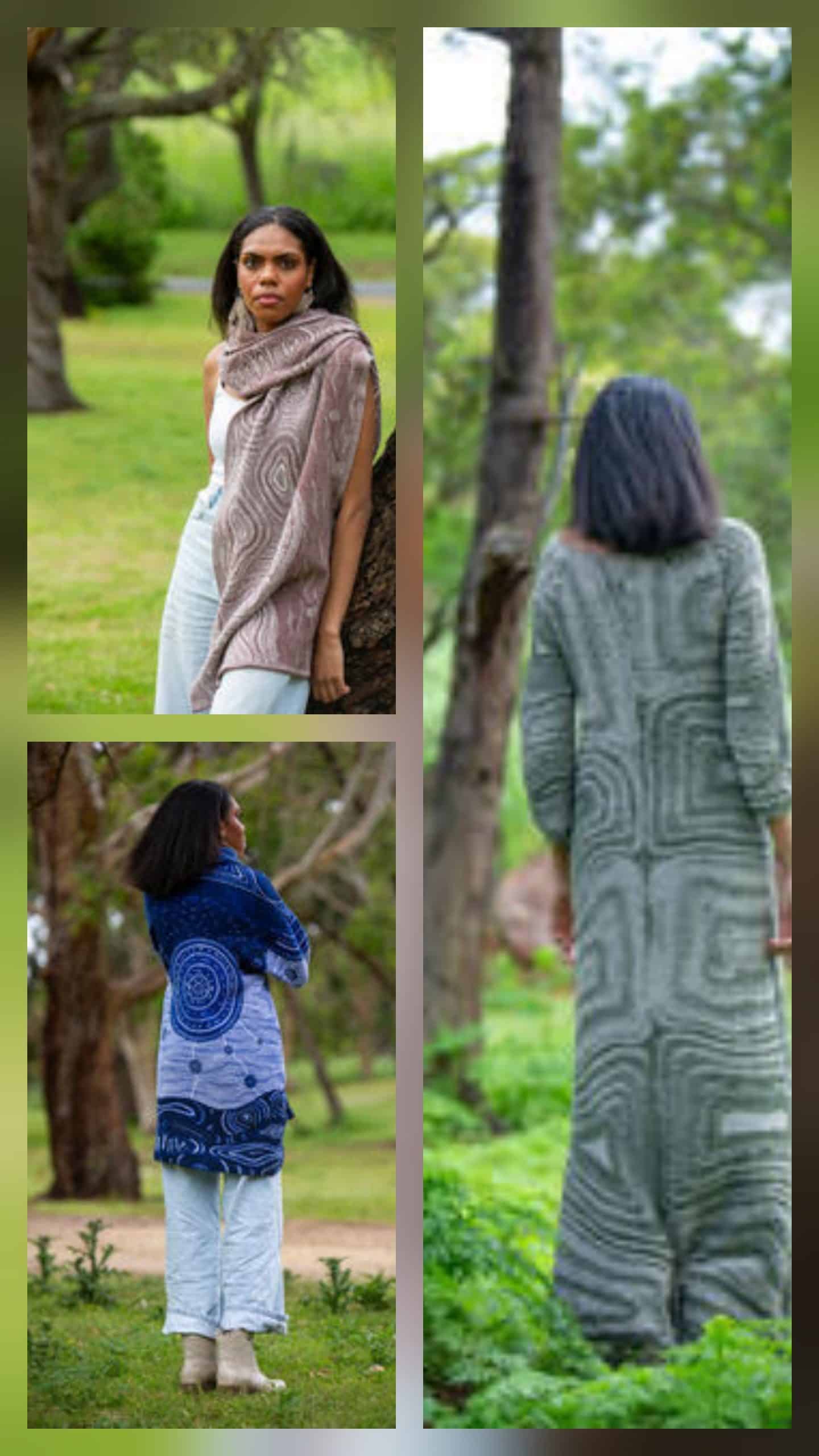
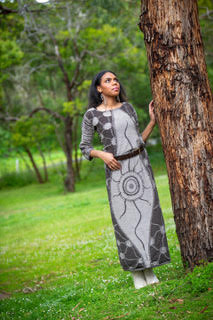
 “My name is Sherry Johnstone, a proud First Nations designer and artist from Warrnambool, Victoria, Australia, living and working on Gunditjmara Country. I’m in my early fifties, and my creative journey has unfolded naturally through my painting, and now onto knitwear”. This is how the creative person with a complex training path presents herself. “Between the ages of 16 -20 I completed a Signwriting Apprenticeship knowing that I wanted to do something around painting and creating when I finished school and although Signwriting was creative, it was creating to a brief for shopfronts and advertising signs etc. mainly hand painting lettering, so it taught me to be very neat and precise, but it wasn’t storytelling like I do now. I worked in various roles throughout our First Nations community for 30 years, then in 2014 onwards, I started to teach myself to paint. This time with stories coming from my own spiritual and cultural experiences, thoughts, and beliefs. I found that over time I would intuitively paint, using traditional symbolism in various ways to represent a First Nations perspective but in a contemporary way, often surprising myself with the amount of meaning and story that my works held. Overtime I realised that this is a natural gift and that people are very interested in the story and often feel moved by the message it carries”.
What does painting mean to you?
Painting for me is a spiritual experience, coming from a deep place within. I am guided subconsciously by an ancestorial presence when I paint, which I trust and embrace, and I continually challenge myself experimenting with different techniques, styles and themes to create versatility.
How did your passion for art begin?
My passion for art began when I was a child. Painting and drawing were always a way for me to express story, and the things I felt but couldn’t put into words. As I grew older, my art became a way to honour my ancestors, sharing culture and to strengthen my connection to Country. My works are inspired by ancestral memory, connection to Country, and intuition. I am guided heavily by curiosity and feeling, constantly inspired by the beauty that surrounds us in nature as well as lived experience being a First Nations woman navigating both tradition and contemporary expression.
How does one of your works come about?
Everything I create holds meaning and always comes from a place where I am remembering the ones that walked before us and what they went through. My ancestors original traditional form of communication was a message stick, a wooden stick made by the chief of the tribe that had motifs carved or burnt into it to communicate to other tribes if there was to be a meeting. There was a messenger in each tribe who would be sent to communicate with the other tribes using the message stick. In today’s world that would be a phone call, email or text message.
I feel that I am now my ancestor’s messenger, I become their voice through my art and storytelling so that we share their wisdom and help other people to learn about, respect and appreciate the oldest living culture in the world. So that my ancestor’s plight and culture live on through me.
How did you end up in the fashion world?
I didn’t come into fashion through a traditional pathway. My background is rooted in community, cultural storytelling, and many years of self driven artistic exploration. Over time, I’ve developed a style that blends contemporary themes with ancient visual language, using my artworks as the foundation for textiles that carry story, movement, and connection. Sometimes my designs feel like they’ve come through me rather than from me.
Were you familiar with Tollegno 1900’s brand before this project?
I first became aware of Tollegno 1900 through my early knitwear research and was aware that Kilmaille Knits knitted on Gunditjmara Country with a Shima Seiki Wholegarment machine using natural fibres being the Tellegno 1900 Harmony extra fine merino wool. After talking with Sue, we realised we both shared a love and passion for the land and wanted to make a difference in this space through slow fashion using sustainable natural fibres, that not only were practical, comfortable, shared story and looked good, but it would most importantly have very low impact on our precious environment, and made on Country on Sue’s farm, which led to me creating and designing some garments. The quality and softness of Harmony wool was something that stood out immediately, and it became an important part of my development as a knitwear designer.
How did you come up with the idea of applying it to the world of knitwear?
The crossover into knitwear happened very naturally. I realised that my artworks could live on more than just canvas, they could move, wrap, flow and exist in everyday life. Knitting allowed me to take storytelling into a new dimension. Instead of hanging on a wall, the stories could be worn, touched, and carried. Giving people the opportunity to step inside the painting, immerse themselves in it and carry and share the message and story it holds. Then they become my messenger! That idea really excited me. It felt like an evolution that honoured both my culture and my creative instincts.
One of your outfits created with Harmony by Tollegno 1900 placed in the top 20 at the recent Wool Museum national competition for new and emerging designers, and you won a scholarship from Deakin University. What characteristics of Harmony do you particularly appreciate?
I came second overall in the National Wool Museums ‘We the Makers’ Sustainable Fashion Prize 2025 which had over 150 entries including entries from 12 different countries and entries from every state and territory in Australia, winning the Deakin University in Geelong Victoria’s Innovation prize for mentorship at their Institute for Frontier Materials. Harmony wool has a softness that feels almost personal — warm, gentle, and comforting on the skin. That matters to me because my designs are rooted in care and connection. I also appreciate how fine, light and versatile Harmony is. It has a beautiful floaty and flexible feel which allows my artwork to translate clearly into stitch, holding detail while still giving movement and drape. The yarn responds beautifully to texture, shaping and colour work, which helps me tell my story the way it deserves to be told.
For the Melbourne Fashion Show in February 2026, you were asked to present a “LookBook.” What will you draw inspiration from?
My Lookbook for the Melbourne Fashion Festival’s First Nations Runway drew inspiration from the natural world, from being out on and connecting with Country, it holds ancestral energy, and my response to this through design. I want to show how my designs are grounded in something older than fashion trends — something deeper. I also take inspiration from shifting pathways and the connection between past and present. I see the Lookbook not just as a catalogue, but as a visual story of where I come from, how I interpret the world through connection and where my design journey is heading. It honours culture while celebrating the innovation of knitwear.
Why did you choose Harmony again as your signature yarn?
It’s a yarn that supports creativity rather than limiting it, and that’s why it resonated with me straight away.